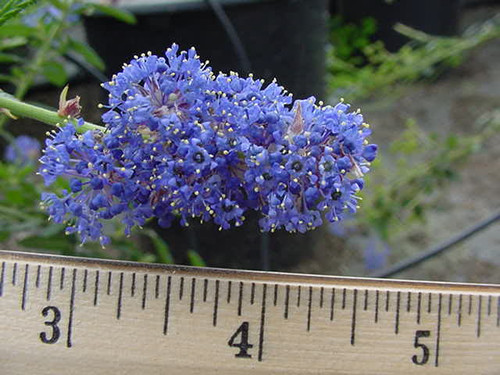
Ceanothus ‘Blue Cascade’ is a California lilac selection developed by John Dourley at Rancho Santa Ana Botanic Garden (now California Botanic Garden) and introduced in 1979. Parentage is generally believed to involve Ceanothus papillosus and C. thyrsiflorus. This evergreen shrub is valued for its blue spring flowers, broad green foliage, and adaptability to a wider range of garden conditions than many California lilac selections.
Habit & Size: Forms a large evergreen shrub approximately 8–10 feet tall and 10–12 feet wide with arching branches and a rounded habit. In late winter through spring, plants produce abundant clusters of light to medium blue flowers that attract native bees, butterflies, and other pollinators.
Cultural Requirements: Performs best in full sun along the coast and light shade in warmer inland locations. Adapted to a variety of well-drained soil types and generally more tolerant of occasional irrigation and garden conditions than many ceanothus selections. Once established, plants perform best with infrequent summer irrigation. Avoid poorly drained soils and frequent summer watering.
Landscape Uses: An excellent choice for screening, informal hedges, slopes, habitat plantings, erosion control, and California native gardens. Useful in coastal landscapes, pollinator gardens, oak woodland edges, and other low-water plantings throughout Southern California. The broad growth habit makes it particularly useful where a large evergreen shrub is needed for screening or background planting.
Identification Note: Distinguished by its relatively large, bright green leaves and softer foliage texture compared to many commonly planted ceanothus cultivars. The foliage is noticeably less rigid and less leathery than selections such as ‘Concha’, ‘Dark Star’, and ‘Julia Phelps’. Leaves are smooth, lance-shaped, and have a matte to slightly waxy surface rather than the smaller, darker, more heavily textured foliage common in many California lilac cultivars.
Pests and Cultural Considerations: Generally low maintenance once established. Like many ceanothus, longevity is reduced by poor drainage and excessive summer irrigation. Best performance is achieved in well-drained soils with good air circulation and infrequent summer water after establishment. Occasional pruning after flowering may be used to manage size and maintain form, though heavy pruning into older wood is best avoided.
- Common Name:
- Wild Lilac Hybrid
- Mature Height:
- 6-8'
- Mature Spread:
- 6-8'
- Exposure:
- Sun
- Growth:
- Evergreen
- Flower Color:
- Light Blue
- Soil:
- Well drained required
- Foliage Color:
- Green
- Flower Time:
- Spring