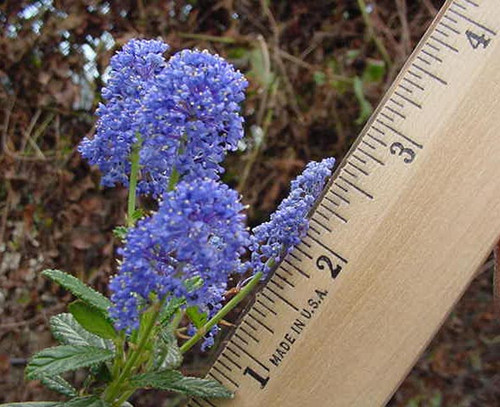
Ceanothus ‘Concha’ (Wild Lilac Hybrid) is a popular evergreen California lilac hybrid valued for its abundant electric-blue to deep violet-blue flowers, glossy dark green foliage, and dense, mounding form. Tight flower clusters cover the rigid, arching branches from late winter into spring, creating a dramatic seasonal display and attracting butterflies, bees, and other pollinating insects. Growing approximately 6–8 feet tall and 8–12 feet wide, ‘Concha’ provides substantial year-round structure and can be used as a flowering specimen, informal hedge, background shrub, or privacy screen. It has shown good performance in coastal and inland Southern California landscapes and greater tolerance of heavy soil than many Ceanothus, provided drainage is adequate and summer irrigation is carefully managed.
Quick Facts:
Botanical Name: Ceanothus ‘Concha’
Common Name: Concha Ceanothus; Wild Lilac Hybrid
Plant Type: Evergreen California native hybrid shrub
Mature Size: Approximately 6–8 feet tall and 8–12 feet wide
Exposure: Full sun to part sun
Water: Low once established; occasional deep irrigation as site conditions require
Soil: Well-drained soil; more tolerant of moderately heavy soil than many Ceanothus
Bloom Season: Late winter through spring
Flower Color: Electric blue to deep cobalt or violet blue
Foliage Color: Glossy dark green
Seasonality: Evergreen
Wildlife Value: Flowers attract butterflies, bees, and other pollinating insects
Growth Rate: Moderate
Habit/Form: Dense, broad, mounding, and arching with rigid branches
Cold Hardiness: Approximately 15°F (-9°C)
Origin: An old California nursery hybrid discovered by Charles Samms at Bee Line Nursery in San Dimas in the 1940s. It is generally believed to involve Ceanothus impressus and Ceanothus papillosus var. roweanus.
California Native: California native hybrid
Landscape Uses: Flowering specimens, informal hedges, privacy screens, background plantings, wildlife gardens, California native gardens, oak-compatible landscapes, Mediterranean gardens, commercial landscapes, and water-wise plantings
Habit & Size: ‘Concha’ develops into a medium to large evergreen shrub with a dense, broadly mounding form. Its rigid branches grow outward and upward, eventually forming a plant approximately 6–8 feet tall and 8–12 feet wide. Narrow, heavily textured leaves remain glossy dark green throughout the year. From late winter into spring, numerous tight clusters of electric-blue to deep cobalt or violet-blue flowers can nearly cover the foliage. Its substantial mature size and dense growth make it useful for screening and background plantings, although adequate space should be provided to preserve its natural form.
Cultural Requirements: Ceanothus ‘Concha’ performs best in full sun and well-drained soil. It has demonstrated good tolerance of inland sun and heat, although light afternoon protection may be beneficial on exceptionally hot or exposed sites. ‘Concha’ is more adaptable to moderately heavy soil than many other Ceanothus, but this does not mean it tolerates waterlogged conditions. Drainage and careful irrigation remain important. Water new plants deeply as needed while roots develop, allowing the soil to dry between irrigations. Mature plants have low water requirements and should not receive frequent summer irrigation. Excessive watering, especially in warm soil or poorly drained locations, can shorten the plant’s lifespan.
Landscape Uses: ‘Concha’ is well suited to California native landscapes, flowering screens, informal hedges, wildlife gardens, Mediterranean plantings, and water-wise residential or commercial landscapes. Its dense evergreen foliage provides year-round structure, while the intense blue flowers make it an exceptional focal point during late winter and spring. It can also be placed in background areas or incorporated into coast live oak and western sycamore landscapes where irrigation is compatible. Because the plant can spread 8–12 feet, it should be positioned where it will not crowd paths, buildings, or smaller neighboring plants.
Identification Note: ‘Concha’ is distinguished by its dense, mounding habit, rigid arching branches, narrow glossy dark green leaves with a heavily wrinkled surface, and numerous tight clusters of electric-blue to deep cobalt or violet-blue flowers. Its exceptionally deep flower color and broad evergreen form distinguish it from many paler-flowered or more loosely branched Ceanothus selections.
Pests and Cultural Considerations: ‘Concha’ is generally low maintenance when planted with adequate drainage and an appropriate irrigation schedule. The most common causes of decline are excessive summer water, poor drainage, and severe pruning into old wood. If shaping is required, prune young growth shortly after flowering. Removing spent flower clusters can encourage a denser appearance and prevent the sections of bare stem that may develop behind old blooms. Avoid pruning in mid- to late winter because this removes developing flower buds, and avoid cutting large older branches because Ceanothus may not reliably produce new growth from old wood. Ceanothus may be browsed by deer and should not be considered reliably deer resistant.
Frequently Asked Questions:
How far apart should ‘Concha’ Ceanothus be planted for a screen? Spacing depends on the desired speed of coverage and whether the shrubs will be allowed to retain their natural form. Because mature plants may spread 8–12 feet, spacing them approximately 8–10 feet apart allows their canopies to meet with less long-term crowding. Closer spacing may create a screen sooner but will require more pruning and can reduce air circulation.
Can ‘Concha’ be maintained as a formal hedge? It is better suited to an informal hedge or flowering screen than a tightly clipped formal hedge. Frequent shearing removes flower buds, creates bare interior wood, and works against the plant’s naturally arching form. Selective pruning immediately after flowering is a better maintenance approach.
Can ‘Concha’ be planted in clay soil? It can tolerate moderately heavy or clay-influenced soil better than many Ceanothus, provided the site drains adequately and the plant is not overwatered. Heavy soil that remains saturated for extended periods is unsuitable. A slope or raised planting area may improve drainage where necessary.
Can ‘Concha’ be planted near a regularly irrigated lawn? It is generally better planted in a separate low-water irrigation zone. Frequent lawn irrigation can keep the surrounding soil wetter than a mature Ceanothus prefers, especially during summer. If planted nearby, consider drainage, irrigation overspray, and the extent of the lawn’s root-zone watering.
Why is my ‘Concha’ Ceanothus producing fewer flowers? Limited flowering may result from insufficient sunlight, pruning during fall or winter, or unusually low winter rainfall. Ceanothus forms flower buds before bloom, so late pruning can remove much of the following display. Plants generally flower most heavily in sunny locations and following normal seasonal rainfall.
Can an overgrown ‘Concha’ be cut back hard? Severe renovation pruning is risky because older Ceanothus branches may not produce new shoots reliably. It is better to prune lightly and regularly while branches are still young. If a mature plant has greatly exceeded its space, replacement may produce a better long-term result than cutting it back into large, leafless wood.
Why are there bare sections behind the spent flowers? After flowering, some stems may show a section with few or no leaves where the flower clusters were produced, followed by leafy growth farther along the branch. Lightly removing spent flower clusters after bloom can help maintain a denser and more uniform appearance.
How should ‘Concha’ be irrigated during its first year? Water deeply enough to moisten the developing root zone, then allow the soil to dry before watering again. Irrigation frequency should be based on soil type, weather, exposure, and root development rather than a fixed calendar. Reduce irrigation as the plant becomes established and avoid frequent summer watering.
Can ‘Concha’ tolerate reflected heat? It has good tolerance of inland sun and heat, but reflected heat from pavement or south- and west-facing walls can increase water stress. Provide adequate planting space, avoid excessive pavement exposure where possible, and monitor new plants carefully while their roots develop.
Why might an established ‘Concha’ Ceanothus suddenly decline? Possible causes include excessive summer irrigation, poor drainage, root disease, or accumulated stress from heat and unsuitable pruning. Review recent irrigation, inspect whether the soil remains wet, and check for symptoms such as branch dieback or discoloration near the base before deciding how to respond.
Is ‘Concha’ suitable for planting beneath mature oak trees? It may be appropriate in oak-compatible landscapes when positioned outside areas where planting would disturb important oak roots and when irrigation remains limited. New Ceanothus should not require frequent summer watering that would conflict with the needs of established native oaks.
Is ‘Concha’ suitable for small gardens or containers? It is generally too large for small planting beds or long-term container use. Its mature spread of 8–12 feet makes it better suited to open landscape areas, screens, and background plantings. A smaller Ceanothus cultivar is usually a better choice where space is limited.
- Common Name:
- Wild Lilac Hybrid
- Mature Height:
- 6-8'
- Mature Spread:
- 8-12'
- Exposure:
- Sun/Part Sun
- Growth:
- Evergreen
- Flower Color:
- Dark Blue
- Soil:
- Well drained best
- Foliage Color:
- Green
- Flower Time:
- Spring