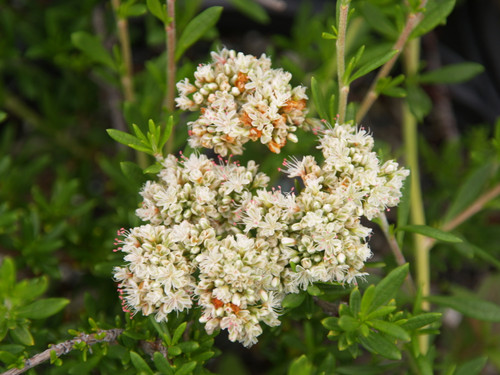
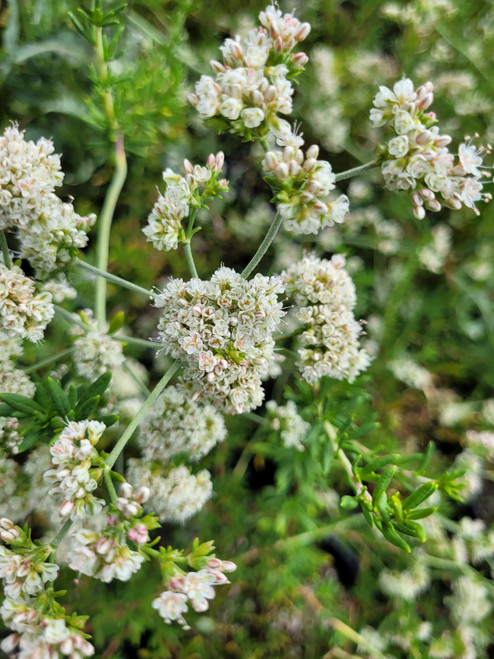
Eriogonum fasciculatum (California Buckwheat, Common Buckwheat) is one of the most widely recognized and useful California native shrubs. The common names California Buckwheat and Common Buckwheat are fitting because this is likely the native buckwheat most familiar to people living in Southern California. It occurs naturally across a broad range of plant communities, from coastal sage scrub and chaparral to inland foothills, valleys, and desert-edge habitats. Because of that wide distribution, considerable variation occurs within the species, including differences in habit, mature size, foliage color, flower density, and overall landscape appearance. California Buckwheat is valued for its fine-textured gray-green foliage, long bloom season, exceptional drought tolerance, and outstanding wildlife value. From spring through fall, clusters of creamy white flowers, often with a slight pink tinge, cover the plant before aging to rusty cinnamon-brown tones during summer and fall. It is especially important in beekeeping and honey production and is one of Southern California’s most valuable native plants for native bees, butterflies, beneficial insects, seed-eating birds, and habitat-oriented landscapes. The straight species is most commonly used in restoration and revegetation projects, while selected forms and cultivars are often better suited to commercial and residential landscape applications. Several lower-growing selections, including ‘Bruce Dickinson’, ‘Warriner Lytle’, and ‘Theodore Payne’, are useful options for larger-scale slope stabilization and coverage projects, particularly in difficult low-water conditions.
Quick Facts:
Botanical Name: Eriogonum fasciculatum
Common Name: California Buckwheat, Common Buckwheat
Plant Type: California native evergreen shrub
Mature Size: Approximately 3–5 feet tall and 3–6 feet wide, depending on form, site conditions, and pruning
Exposure: Full sun to part sun
Water: Very low once established
Soil: Well-drained soil preferred; adaptable to sandy, rocky, decomposed granite, and native soils
Bloom Season: Spring through fall
Flower Color: Creamy white, often with a slight pink tinge, aging to rusty cinnamon-brown
Foliage Color: Gray-green
Growth Rate: Moderate
Wildlife Value: Excellent nectar source for native bees, butterflies, beneficial insects, and honeybees; important in honey production; mature seed heads provide food for birds
Origin: California and adjacent regions of the western United States and Baja California
California Native: Yes
Landscape Uses: Restoration projects, revegetation, California native gardens, slopes, erosion control, pollinator gardens, dry borders, habitat plantings, commercial landscapes, residential landscapes, and water-wise landscapes
Habit & Size: California Buckwheat forms a rounded to mounding evergreen shrub, commonly reaching 3–5 feet tall and 3–6 feet wide. Because the species has a wide natural distribution from coastal to inland plant communities, plants may vary noticeably in height, density, leaf size, flower production, and overall form. Its narrow gray-green leaves create a fine-textured appearance that provides year-round structure. Flower clusters appear over a long season, beginning creamy white to pale pink and gradually aging to rusty cinnamon-brown. These persistent flower heads are one of the plant’s most useful ornamental and wildlife features, extending visual interest well beyond the main bloom period.
Cultural Requirements: Eriogonum fasciculatum performs best in full sun to part sun and adapts to a wide range of well-drained soils. Once established, it is typically carefree and requires very little supplemental irrigation. It is highly tolerant of heat, drought, and difficult Southern California growing conditions. Avoid excessive summer irrigation, particularly in heavy or slow-draining soils. Where the plant is used ornamentally, light annual pruning in late fall or winter helps refresh the plant, encourage vigorous new spring growth, and maintain a denser, cleaner form. Avoid severe pruning into old woody stems, as older wood may not respond well.
Landscape Uses: California Buckwheat is useful in California native landscapes, water-wise gardens, pollinator gardens, habitat restoration, revegetation projects, slopes, erosion-control plantings, dry borders, commercial landscapes, and naturalistic residential landscapes. The straight species is especially valuable in restoration and revegetation work because of its adaptability, broad native range, drought tolerance, and ecological value. For more refined commercial or residential applications, selected forms and cultivars may provide lower height, denser coverage, or a more uniform appearance. Its long bloom season provides nectar for native bees, butterflies, beneficial insects, and honeybees, while the mature seed heads support birds and add fall and winter texture. Lower-growing cultivars such as ‘Bruce Dickinson’, ‘Warriner Lytle’, and ‘Theodore Payne’ can be especially useful where broader coverage or lower slope stabilization is desired.
Identification Note: Eriogonum fasciculatum is distinguished by its narrow gray-green leaves, dense branching habit, and rounded clusters of creamy white flowers that often show a slight pink tinge before maturing to rusty cinnamon-brown. This color change, common in many Eriogonum species, provides ornamental value long after the fresh flowers have faded. Because the species is naturally variable across its wide range, plants from different seed sources or selections may differ noticeably in size, density, and appearance. It should not be confused with annual culinary buckwheat; California Buckwheat is a woody native shrub in the buckwheat family.
Pests and Cultural Considerations: California Buckwheat is generally free of significant pest and disease problems when grown in well-drained soils with limited irrigation. Established plants are typically very low maintenance and often carefree in appropriate sites. Excessive irrigation or poor drainage can reduce vigor
Frequently Asked Questions:
Is Eriogonum fasciculatum native to California? Yes. California Buckwheat is native throughout much of California and occurs naturally in coastal sage scrub, chaparral, foothills, valleys, and desert-edge plant communities.
Why is it called California Buckwheat or Common Buckwheat? These names are appropriate because Eriogonum fasciculatum is one of the most widespread and familiar native buckwheats in Southern California. It is likely the buckwheat most people recognize from local native landscapes, slopes, roadsides, and restoration plantings.
Is California Buckwheat drought tolerant? Yes. Once established, California Buckwheat is extremely drought tolerant and thrives with minimal supplemental irrigation, making it an excellent choice for water-wise landscapes.
Why is California Buckwheat important for pollinators and honey production? California Buckwheat is one of California’s most valuable native nectar plants. Its abundant flowers attract native bees, butterflies, beneficial insects, honeybees, and other pollinators over an extended bloom season. It is also important in beekeeping because it can contribute to honey production where large stands are present.
Is California Buckwheat important for butterflies and birds? Yes. The flowers support butterflies and other beneficial insects, while mature seed heads provide food for birds. It is one of the most useful native shrubs for habitat-oriented Southern California landscapes.
Do the flowers change color? Yes. The creamy white flowers often have a slight pink tinge and gradually mature to rusty cinnamon-brown during summer and fall, extending the plant’s ornamental value well beyond the fresh bloom period.
Why do different California Buckwheat plants look different? Large natural variation occurs within the species because it has a wide distribution from coastal to inland plant communities. Plant size, density, foliage color, and flower production may vary depending on genetics, seed source, site conditions, irrigation, and pruning.
When should California Buckwheat be pruned? Light pruning is best done in late fall or winter after flowering. In ornamental plantings, annual pruning helps refresh the plant, encourage new growth in spring, and maintain a denser, cleaner shape. Avoid cutting hard into old woody stems.
Should spent flower heads be removed? They can be removed for a cleaner maintained appearance, but leaving some seed heads provides food for birds and adds fall and winter interest.
Is California Buckwheat good for restoration and revegetation? Yes. The straight species is commonly used in restoration and revegetation projects because it is adaptable, drought tolerant, ecologically valuable, and widely native across many California plant communities.
Are there selections better suited for commercial or residential landscapes? Yes. A number of selections are better suited to ornamental, commercial, and residential applications where a more specific height, form, or appearance is desired. Lower-growing selections such as ‘Bruce Dickinson’, ‘Warriner Lytle’, and ‘Theodore Payne’ can be excellent choices for larger-scale slope stabilization and coverage projects where a lower habit is preferred.
Is California Buckwheat good for erosion control? Yes. Its drought tolerance, dense growth habit, and adaptation to dry slopes make California Buckwheat useful for stabilizing slopes, controlling erosion, and restoring native habitats.
What problems should be avoided? Avoid frequent summer irrigation, poor drainage, and severe pruning into old woody stems. These are the most common causes of decline in maintained landscapes.
- Common Name:
- California Buckwheat
- Mature Height:
- 3-5'
- Mature Spread:
- 3-6'
- Exposure:
- Sun/Part Sun
- Growth:
- Evergreen
- Flower Color:
- White/Pink
- Flower Time:
- Spring - Fall