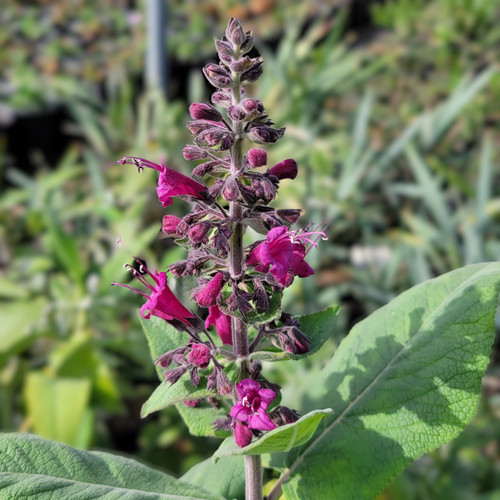
Lepechinia fragrans (Pitcher Sage, Fragrant Pitcher Sage) is a fast-growing, shrubby evergreen perennial native to the coastal mountains of Southern California and the Channel Islands. It is valued for its fuzzy blue-green foliage, strong fragrance, light pink to lavender flowers, and usefulness in shade, woodland, habitat, and California native plantings. Flowers appear in spring and fall and attract bees, butterflies, hummingbirds, and other pollinators. Pitcher Sage grows well in part shade to shade, although it may tolerate more sun in mild coastal locations. In hotter inland landscapes, partial shade and protection from intense afternoon sun are preferable. Plants may lose foliage during severe heat or drought, and regular pruning helps maintain a tidier, more compact appearance.
Quick Facts:
Botanical Name: Lepechinia fragrans
Common Name: Pitcher Sage, Fragrant Pitcher Sage
Plant Type: California native shrubby evergreen perennial
Mature Size: Approximately 3–5 feet tall and 3–5 feet wide
Exposure: Part shade to shade; may tolerate more sun in mild coastal locations
Water: Low to moderate once established; occasional deep irrigation may improve appearance during prolonged inland heat
Soil: Moisture-retentive but adequately drained soils; tolerant of clay
Bloom Season: Spring and fall
Flower Color: Light pink to lavender
Foliage Color: Fuzzy blue-green
Seasonality: Generally evergreen; may become semi-deciduous or temporarily summer-deciduous during severe heat or drought
Wildlife Value: Flowers attract bees, butterflies, hummingbirds, and other pollinators
Origin: Coastal mountains of Southern California and the Channel Islands
California Native: Yes
Landscape Uses: Shade and woodland gardens, California native gardens, understory plantings, habitat and pollinator gardens, shaded borders, naturalistic landscapes, residential landscapes, and selected commercial plantings
Habit & Size: Pitcher Sage forms an open, mounding shrub approximately 3–5 feet tall and wide, with arching, multibranched stems. Its fuzzy blue-green foliage provides soft texture and releases a strong fragrance—sometimes described as pungent—when touched or crushed. Light pink to lavender flowers appear in spring and fall. The plant can become open or somewhat sprawling as it matures, and fairly regular pruning helps maintain a fuller, tidier, and more compact form.
Cultural Requirements: Lepechinia fragrans performs well in part shade to shade and is especially suited to shaded and woodland-style gardens. In mild coastal Southern California locations, it may tolerate greater sun exposure. In hotter inland landscapes, partial shade and protection from intense afternoon sun are preferable. It favors soil that retains some moisture while remaining adequately drained and is tolerant of clay. Provide regular irrigation during establishment. Once established, plants can be maintained with low to moderate supplemental water, adjusted for exposure, soil, and local climate. Occasional deep irrigation during prolonged inland heat may help maintain foliage, but continuously saturated soil should be avoided.
Landscape Uses: Pitcher Sage is useful in California native gardens, shade and woodland gardens, understory plantings, pollinator gardens, habitat landscapes, shaded borders, and naturalistic designs. Its fuzzy blue-green foliage contributes soft texture, while its aromatic leaves provide sensory interest beside paths and in locations where people may brush against the plant.
For landscape designers, Pitcher Sage can create a layered transition between native trees or large shrubs and lower-growing woodland perennials. It can be combined with western sycamore, western redbud, Ribes, coral bells, Douglas iris, and other plants with compatible exposure, soil, and irrigation requirements.
Pitcher Sage can also be used in shaded or naturalistic commercial landscapes where its fragrance, wildlife value, and informal character support the design. Its open habit, periodic pruning requirements, possible foliage loss during severe inland heat or drought, and reportedly shorter lifespan in Inland Empire landscapes should be considered where long-term uniformity or a consistently dense appearance is required. It is better suited to informal native, woodland, and habitat-oriented designs than to tightly clipped hedges or highly uniform mass plantings.
Identification Note: Lepechinia fragrans is recognized by its fuzzy blue-green foliage, strong fragrance, arching growth, and light pink to lavender flowers. Its stems are square, a characteristic shared by many members of the mint family. Although it is commonly called a sage, it belongs to the genus Lepechinia rather than the true-sage genus Salvia.
Pests and Cultural Considerations: Pitcher Sage is generally low maintenance when grown under suitable conditions, but its fast growth and naturally open habit may require fairly regular pruning to maintain a clean, compact form. Pinching young growth encourages greater density. Plants that look spent can be cut back in winter before fresh spring growth begins; if winter pruning is missed, plants can be reduced in early spring. Severe inland heat or drought may cause partial or complete temporary foliage loss. The species may be relatively short-lived in Inland Empire landscapes, so eventual replacement should be considered when it is specified for permanent commercial installations. Soil should retain some moisture but must not remain continuously saturated.
Frequently Asked Questions:
Why is my Pitcher Sage losing its leaves? Severe heat or drought can cause temporary foliage loss, particularly in hot inland landscapes. This seasonal response does not necessarily mean the plant has died, and foliage may return when growing conditions improve.
Is Pitcher Sage suitable for commercial landscapes? It can be effective in shaded, naturalistic, native, and habitat-oriented commercial landscapes. Designers should consider its informal habit, pruning needs, possible inland foliage loss, and reportedly shorter lifespan before using it where a consistently dense and highly formal appearance is required.
What makes Pitcher Sage useful to landscape designers? Pitcher Sage combines fuzzy blue-green foliage, strong fragrance, light pink to lavender flowers, pollinator value, fast growth, and tolerance of partial shade. These characteristics make it particularly useful in layered California native woodland gardens, habitat landscapes, shaded borders, and naturalistic planting designs.
- Common Name:
- Pitcher Sage
- Mature Height:
- 3-5'
- Mature Spread:
- 3-5'
- Exposure:
- Part Shade/Shade
- Growth:
- Evergreen
- Flower Color:
- Pink/Lavender