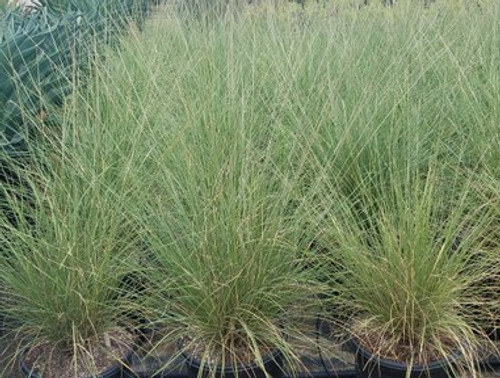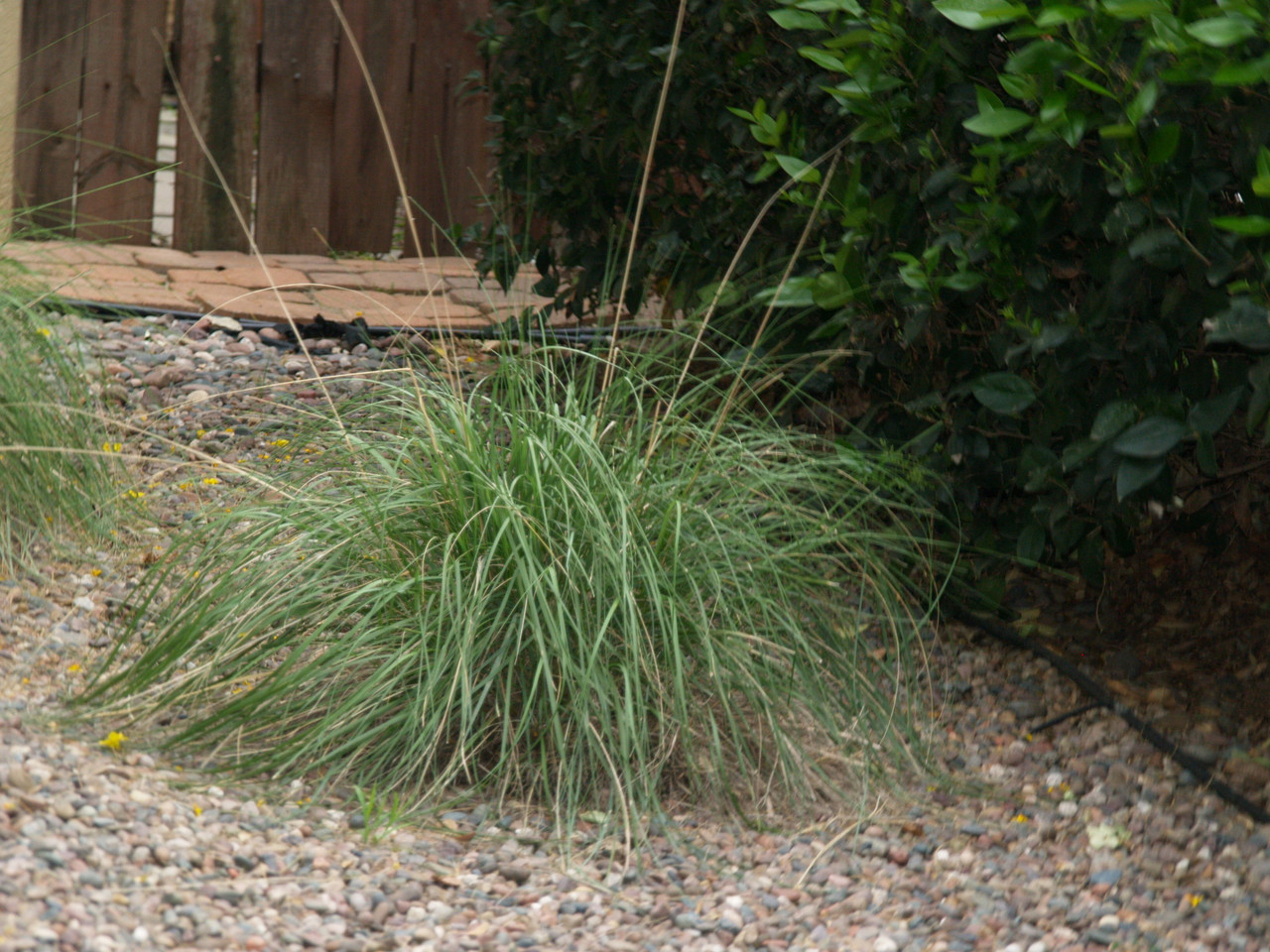

Muhlenbergia rigens (Deergrass) is a durable California native warm-season bunchgrass valued for its graceful foliage, drought tolerance, adaptability, and tall architectural flower stalks. It forms dense mounds of narrow green foliage approximately 2–4 feet tall and 2–3 feet wide. During summer, slender, rigid flower stalks rise an additional 2–3 feet above the foliage and remain attractive through fall. Deergrass can grow in both dry and regularly irrigated gardens when provided with well-drained soil. Once established, it can survive without supplemental summer irrigation in many areas, although occasional deep watering generally keeps the foliage fuller and more attractive. Despite its common name, Deergrass is remarkably deer resistant.
Quick Facts:
Botanical Name: Muhlenbergia rigens
Common Name: Deergrass; Deer Grass
Plant Type: California native warm-season bunchgrass
Mature Size: Approximately 2–4 feet tall and 2–3 feet wide; flower stalks rise an additional 2–3 feet above the foliage
Exposure: Full sun to light shade
Water: Low once established; can grow without summer irrigation in many areas but generally looks fuller with occasional water
Soil: Adaptable to several soil types; well-drained soil required
Bloom Season: Summer through fall
Flower Color: Cream when emerging, aging to tan or straw
Foliage Color: Green to pale green
Seasonality: Evergreen to semi-deciduous depending on climate, irrigation, and growing conditions
Wildlife Value: Provides cover, nesting material, seeds, and habitat for birds, beneficial insects, and other wildlife
Growth Rate: Moderate to fast under favorable conditions
Habit/Form: Dense, clumping, fountain-like, mounding, and arching
Origin: California, the southwestern United States, and northern Mexico
California Native: Yes
Landscape Uses: California native gardens, commercial landscapes, mass plantings, borders, banks, bioswales, dry streambeds, meadow plantings, habitat gardens, restoration projects, erosion-control plantings, raised planters, containers, parks, civic spaces, and water-wise landscapes
Habit & Size: Deergrass forms a dense, fountain-like clump of narrow green leaves approximately 2–4 feet tall and 2–3 feet wide. During summer, thin, rigid flower stalks emerge and rise an additional 2–3 feet above the foliage. The developing flower panicles may begin cream-colored before aging to tan or straw. They persist into fall and often remain visually effective into winter, providing strong vertical structure and movement. Flowering plants can occupy more horizontal space than the foliage mound alone, which should be considered when placing Deergrass near sidewalks, driveways, and other pedestrian areas.
Cultural Requirements: Muhlenbergia rigens performs best in full sun but tolerates light shade. When planted in dense shade, its foliage may lose its upright form and collapse onto itself, significantly reducing its ornamental value. Deergrass adapts to a range of soil types, including sandy, rocky, loamy, and some clay soils, provided drainage is adequate. It can be used in both dry and regularly irrigated landscapes, but the soil should not remain continuously saturated. Once its root system has developed, Deergrass can grow without supplemental summer irrigation in many areas. Occasional deep watering generally produces fuller, greener foliage and a more refined appearance, particularly in maintained residential and commercial landscapes.
Landscape Uses: Deergrass is useful in California native gardens, water-wise landscapes, mass plantings, commercial projects, parks, civic spaces, meadow gardens, bioswales, dry streambeds, raised planters, banks, borders, habitat gardens, and restoration projects. Its dense foliage provides substantial year-round texture, while the tall flower stalks create vertical accents and strong silhouettes through fall and winter. It can be planted in repeating groups for a formal rhythm or arranged more loosely among boulders, flowering perennials, and native shrubs for a naturalistic effect. Although drought tolerant, it can also be incorporated into moderately irrigated landscapes if the soil drains well and the irrigation schedule does not keep the root zone constantly wet.
Identification Note: Muhlenbergia rigens is recognized by its dense clumps of narrow green foliage and the tall, thin, rigid flower stalks that rise well above the leaves. In recent years, it has been replaced in some commercial landscapes by Muhlenbergia dubia, a similar-looking grass native to Mexico. Muhlenbergia dubia is generally more compact and rigid, is also highly drought tolerant, and is considered by some landscape professionals to be more durable. However, M. rigens remains the appropriate choice when a California native species or locally suitable native plant is required. Its more graceful foliage and taller flower stalks also provide a different landscape character from the tighter form of M. dubia.
For several years, large quantities of inferior Muhlenbergia rigens seed were distributed commercially, resulting in inconsistent, poor-quality plants that harmed the species’ reputation in the landscape industry. Those inferior strains have largely disappeared from current production, and better seed sources once again demonstrate the ornamental and practical value of properly grown Deergrass. Variation may still occur in seed-grown material, so uniformity should be evaluated when specifying large quantities for formal commercial installations.
Pests and Cultural Considerations: Deergrass is generally free of significant pest and disease problems. Its most common cultural problems are poor drainage, excessive shade, and improper maintenance. Dense shade may cause the foliage to collapse, while persistently wet soil can reduce vigor. Old leaves and broken flower stalks can be removed with a leaf rake whenever needed. Plants may be cut back hard to approximately 6–9 inches in early spring to renew the foliage, but this is usually necessary only every two or three years rather than annually. Periodic division may also be performed in late fall or winter when older clumps become overly dense. Deergrass is remarkably deer resistant despite its common name, although no plant is completely immune to browsing under all conditions.
Frequently Asked Questions:
How far apart should Deergrass be planted? Spacing depends on the desired effect and whether the flower stalks are allowed to remain at full size. Approximately 3–4 feet between plant centers can create a relatively continuous mass, while wider spacing preserves the outline of each individual clump. Remember that the flower stalks may arch beyond the 2- to 3-foot-wide foliage mound.
How close can Deergrass be planted to a sidewalk or driveway? Allow enough setback for the mature flower stalks as well as the foliage. Although the foliage mound is approximately 2–3 feet wide, a plant in full flower can occupy considerably more space from stalk tip to stalk tip. A setback of approximately 2–3 feet from the pavement edge can reduce the need for repeated trimming.
Does Deergrass spread by underground runners? No. Deergrass is a clumping bunchgrass rather than an aggressively running grass. Its clump gradually increases in diameter, but it does not normally travel through the landscape by long underground rhizomes in the manner of invasive running grasses.
Can Deergrass be divided? Yes. Established clumps can be divided periodically when they become too large or dense. Late fall or winter is generally the best time for division because cooler conditions place less stress on the plants than active summer growth.
Can Deergrass be grown in a container? Yes. Deergrass can be grown in a large container or raised planter that provides adequate drainage and enough space for its mature foliage and flower stalks. Container plants generally require more frequent irrigation than plants growing in the ground, but the potting medium should still be allowed to drain between waterings.
Is Deergrass appropriate for bioswales and dry streambeds? It can be useful in bioswales and dry streambeds where water drains or infiltrates after storms. It should not be placed in a permanently saturated basin or a location where water stands around the crown for extended periods.
Does Deergrass need fertilizer? Routine fertilizer is generally unnecessary in typical landscape soil. Excessive nitrogen may produce soft, overly lush foliage that loses the plant’s naturally upright form. Appropriate sunlight, drainage, spacing, and irrigation are usually more important than supplemental feeding.
Can Deergrass be planted near a swimming pool? It can provide attractive movement and architectural texture near pools, but the persistent flower stalks and seasonal plant debris should be considered. Place it far enough from the water and surrounding pavement that arching stalks do not interfere with circulation or create unnecessary maintenance.
Is Deergrass suitable for California native restoration projects? Yes, when it is appropriate to the project location and plant community. For ecological restoration, the source and geographic origin of the seed should be considered because locally appropriate material may be more important than the uniform appearance expected in an ornamental landscape.
Why might Deergrass look different from one landscape to another? Differences in genetics, sunlight, irrigation, soil, age, and maintenance can all influence its appearance. Plants grown with occasional irrigation may appear fuller and greener, while those in dry conditions may be leaner. Dense shade can produce floppy foliage, and seed-grown plants may display natural variation.
- Common Name:
- Deergrass
- Mature Height:
- 2-4'
- Mature Spread:
- 2-3'
- Exposure:
- Sun/Part Sun
- Growth:
- Evergreen
- Flower Color:
- Tan
- Soil:
- Not particular
- Foliage Color:
- Green
- Flower Time:
- Summer - Fall