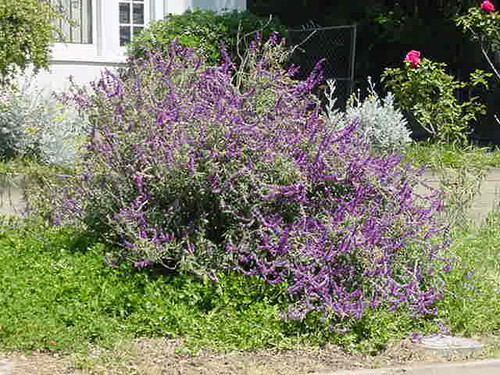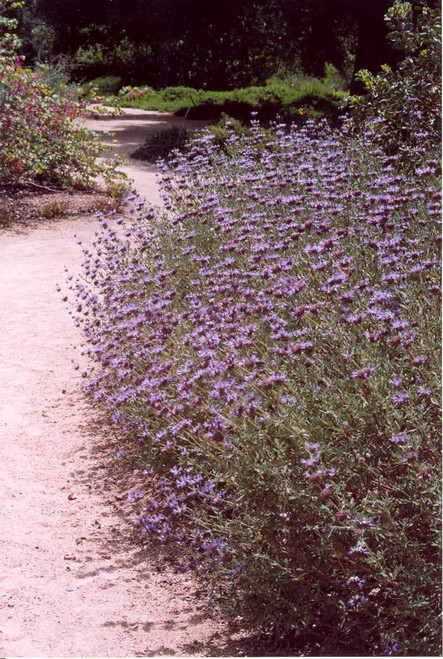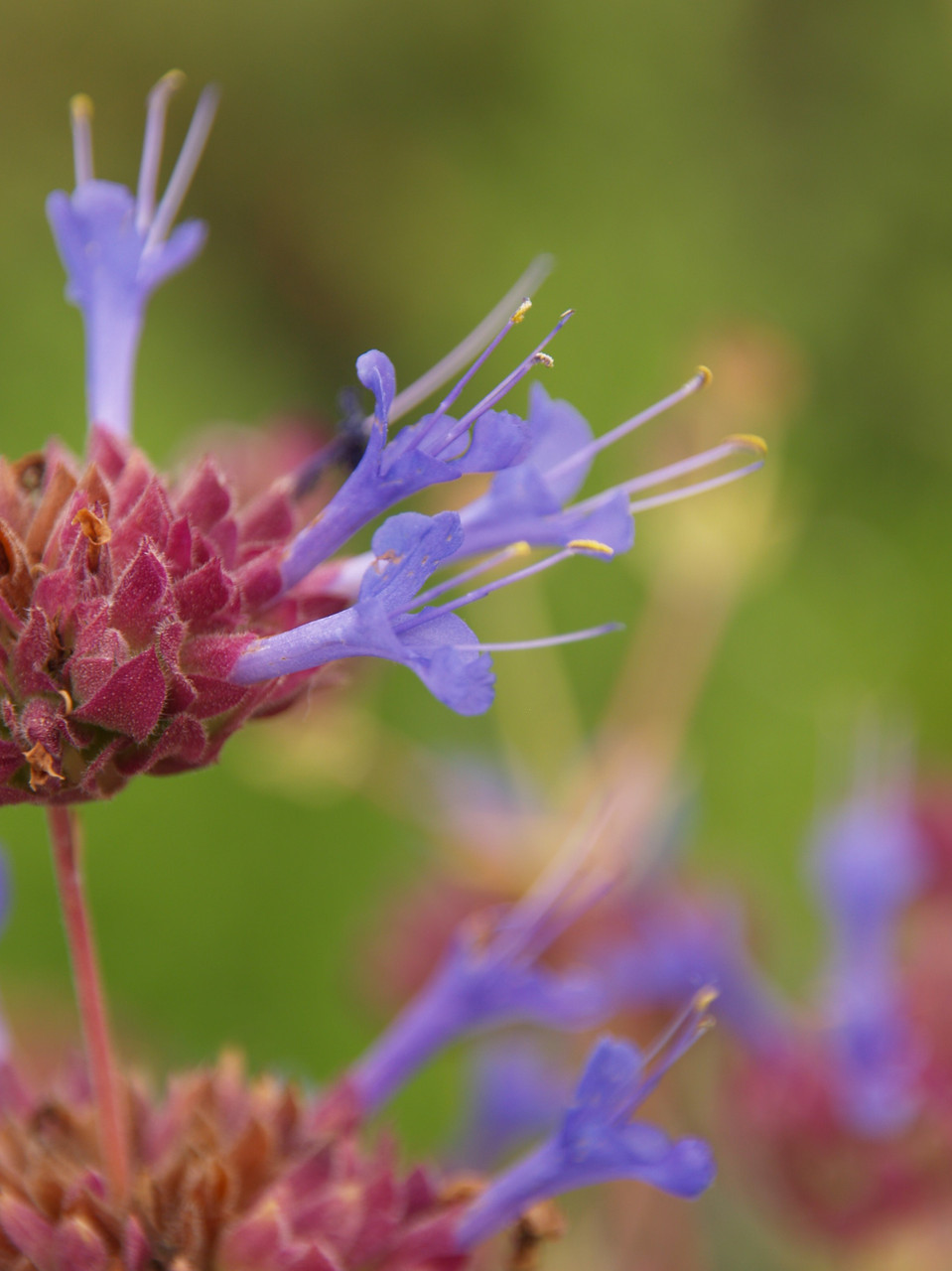

Salvia clevelandii ‘Winifred Gilman’ (Cleveland Sage Selection) is a compact selection of true Cleveland Sage valued for its intensely fragrant foliage and abundant whorls of dark purple, violet, or blue flowers. Unlike the larger-leaved, gray-green Salvia clevelandii × Salvia leucophylla hybrids frequently sold as Cleveland Sage, ‘Winifred Gilman’ has smaller, dark green leaves that give it a finer texture. Its sweetly aromatic foliage and richly colored flowers make it one of the most distinctive California native sages for smaller landscapes. During spring and early summer, the flowers attract hummingbirds, swallowtail butterflies, bees, and other pollinators. Although highly ornamental, ‘Winifred Gilman’ can experience more landscape problems than common Cleveland Sage hybrids and is best used where drainage, irrigation, and pruning can be monitored carefully.
Quick Facts:
Botanical Name: Salvia clevelandii ‘Winifred Gilman’
Common Name: Winifred Gilman Cleveland Sage; Cleveland Sage Selection
Plant Type: California native evergreen shrub
Mature Size: Approximately 3–5 feet tall and wide
Exposure: Full sun to light shade
Water: Very low once established; exceptionally sensitive to excessive summer irrigation
Soil: Well-drained soil required
Bloom Season: Spring into early summer
Flower Color: Dark purple, violet, or blue
Foliage Color: Dark green
Seasonality: Evergreen, although appearance may vary with drought and site conditions
Wildlife Value: Flowers attract hummingbirds, swallowtail butterflies, bees, and other pollinators; retained seed heads may provide additional wildlife value
Growth Rate: Moderate
Habit/Form: Compact, dense, rounded, and mounding
Cold Hardiness: Approximately 15–25°F, depending on site conditions and plant maturity
Origin: Garden selection introduced by Strybing Arboretum, now the San Francisco Botanical Garden
California Native: Yes
Landscape Uses: California native gardens, pollinator gardens, hummingbird gardens, fragrant gardens, dry borders, banks, slopes, smaller residential plantings, Mediterranean landscapes, and water-wise gardens
Habit & Size: ‘Winifred Gilman’ forms a compact, rounded shrub approximately 3–5 feet tall and wide. Its relatively small, dark green leaves have a textured surface and release a strong, sweet fragrance. Distinct whorls of dark purple, violet, or blue flowers are carried above the foliage in abundance during spring and early summer. Its manageable size, fine-textured foliage, intense fragrance, and vivid flower color make it useful as a flowering or foliage accent in smaller California native landscapes.
Cultural Requirements: Salvia clevelandii ‘Winifred Gilman’ performs best in full sun and well-drained soil. It tolerates light shade, although insufficient sunlight can reduce flowering and produce a looser habit. Once its root system has developed, the plant requires very little supplemental irrigation and can perform well in inland Southern California landscapes with little summer water. It is exceptionally sensitive to overwatering during warm weather, particularly where drainage is slow. Water new plants deeply but allow the soil to dry between irrigations. Mature plants should be separated from lawns and other frequently irrigated plantings. Decomposed granite or natural leaf litter may be used to cover bare soil around the plant.
Landscape Uses: ‘Winifred Gilman’ is appropriate for California native landscapes, fragrant gardens, pollinator and hummingbird gardens, Mediterranean plantings, dry borders, slopes, banks, and smaller residential gardens. Its compact habit makes it easier to accommodate than many larger native sages, while its aromatic foliage and dark, intensely colored flowers provide strong seasonal interest. Because this true-species selection can be less forgiving than commonly grown Cleveland Sage hybrids, it is best specified where irrigation can be controlled and maintenance crews understand its pruning requirements. It is not an ideal selection for extensively irrigated commercial landscapes or installations where all shrubs receive the same watering and pruning treatment.
Identification Note: ‘Winifred Gilman’ is a selection of the true species Salvia clevelandii. It differs from the Salvia clevelandii × Salvia leucophylla hybrids commonly sold under the Cleveland Sage name by having smaller, dark green foliage rather than the larger gray-green leaves typical of many hybrid forms. Its compact rounded habit, sweet fragrance, and abundant whorls of dark purple, violet, or blue flowers are its primary identifying features. Cultivar-name spelling varies in the nursery trade, but El Nativo lists the plant as ‘Winifred Gilman’.
Pests and Cultural Considerations: ‘Winifred Gilman’ is generally free of major pest problems, but it can experience more difficulties in the landscape than the commonly grown Salvia clevelandii × Salvia leucophylla hybrids. It is exceptionally sensitive to excessive summer irrigation, particularly in poorly drained soil. Cut the plant back annually after flowering, preferably in late summer to early fall when extreme heat is not expected, to encourage fresh growth and abundant flowering the following spring. Always retain healthy leaves and at least two leafy nodes below each pruning cut. Cutting into bare old wood may cause severe dieback or kill the shrub, especially if pruning is performed during hot summer weather. Young plants may also be pinched or lightly pruned to encourage a strong, bushy framework. Allowing young plants to develop numerous long flower stalks before forming sturdy branches may result in breakage. Some dry flower or seed heads may be retained to provide food, nesting material, and habitat for birds and other wildlife.
Frequently Asked Questions:
How far apart should ‘Winifred Gilman’ Cleveland Sage be planted? Allow approximately 4–5 feet between plants when the goal is to preserve their individual rounded forms. Slightly closer spacing can create a continuous mass planting, but additional pruning may eventually be required. Keep plants far enough from walkways to prevent mature branches and flower stalks from extending into pedestrian areas.
How cold hardy is ‘Winifred Gilman’ Cleveland Sage? Published nursery references vary, placing its approximate cold tolerance between 15°F and 25°F. Actual performance depends on the duration of the freeze, drainage, plant maturity, and local conditions. Young or recently planted specimens may be more vulnerable than mature plants.
Who introduced ‘Winifred Gilman’ Cleveland Sage? ‘Winifred Gilman’ was introduced as a garden selection by Strybing Arboretum, now known as the San Francisco Botanical Garden. Some references indicate that it was named for one of the plant’s propagators.
Why is this cultivar’s name sometimes spelled differently? The cultivar appears in the nursery trade as both ‘Winifred Gilman’ and ‘Winnifred Gilman’, with occasional variations in the spelling of the surname. El Nativo lists the plant as Salvia clevelandii ‘Winifred Gilman’, which should be used consistently on the product page.
Can ‘Winifred Gilman’ Cleveland Sage be grown in a container? It may be grown in a large container for a limited period, but long-term container culture can be challenging. The potting medium must drain rapidly, and irrigation requires careful monitoring because container-grown roots are more exposed to repeated wetting and heat. Its mature size of approximately 3–5 feet also requires a substantial container.
Does ‘Winifred Gilman’ Cleveland Sage need fertilizer? Routine fertilizer is generally unnecessary when the plant is growing in appropriate soil. Excess fertilizer may encourage soft, overly vigorous growth that weakens its compact form. Proper sunlight, drainage, and irrigation are more important than supplemental feeding.
Where should ‘Winifred Gilman’ be planted so its fragrance can be appreciated? It can be placed near a patio, entry, seating area, or garden path where sunlight and light contact release the foliage’s fragrance. Because people differ in how they perceive its strong scent, evaluate the fragrance before placing several plants immediately beside frequently occupied areas.
What plants pair well with ‘Winifred Gilman’ Cleveland Sage? It combines best with sun-loving, drought-adapted plants that require similarly low levels of summer irrigation. Suitable design companions may include California buckwheats, penstemons, California fuchsia, deer grass, and other dry-growing native sages. Final selections should be matched for exposure, drainage, mature size, and irrigation requirements.
Is ‘Winifred Gilman’ suitable for mass planting? It can create an effective fragrant and pollinator-oriented mass planting, but it requires more careful irrigation and pruning than many common Cleveland Sage hybrids. Mass planting is most appropriate where the entire area can be managed as a very-low-water hydrozone and maintenance crews understand that the shrubs should not be sheared or cut into bare wood.
- Common Name:
- Cleveland Sage Selection
- Mature Height:
- 3-5'
- Mature Spread:
- 3-5'
- Exposure:
- Sun/Light Shade
- Growth:
- Evergreen
- Flower Color:
- Dark Purple
- Soil:
- Well drained required
- Foliage Color:
- Green
- Flower Time:
- Spring - Summer