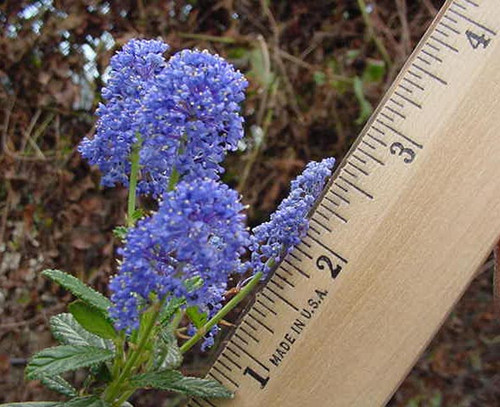
Ceanothus ‘Wheeler Canyon’ is a California native Ceanothus selection discovered by Dara Emery in Wheeler Gorge, Ventura County, and introduced by Santa Barbara Botanic Garden in the early 1980s. Selected from native populations in Ventura County, it was chosen for its dense growth habit, adaptability to garden conditions, and abundant display of blue spring flowers. Often compared to the widely grown cultivar ‘Concha’, ‘Wheeler Canyon’ typically develops a somewhat smaller habit, broader foliage, and lighter blue flowers. Habit & Size: Forms a dense evergreen shrub typically 4–6 feet tall and 6–10 feet wide with arching branches and small, glossy, dark green leaves. In early spring, plants are covered with masses of rich blue flower clusters emerging from attractive burgundy-colored buds. The flowers are highly attractive to native bees, butterflies, and other pollinators. Cultural Requirements: Performs best in full sun to light shade and adapts to a remarkably wide range of soil types, including clay soils, provided drainage is adequate. More tolerant of garden conditions and occasional irrigation than many Ceanothus selections, making it a reliable choice for both residential and commercial landscapes. Once established, it is highly drought tolerant and exceptionally well suited to Southern California's Mediterranean climate. Landscape Uses: An excellent choice for screening, informal hedges, slopes, banks, erosion control, habitat plantings, and California native gardens. Useful in coastal landscapes, oak woodland plantings, pollinator gardens, wildlife habitat plantings, low-water landscapes, fuel-modified native landscapes, and restoration projects. Among California native ceanothus selections, ‘Wheeler Canyon’ is notable for its adaptability to garden conditions, including heavier soils and occasional irrigation. This combination of durability, drought tolerance, and reliable flowering has made it a longstanding favorite for Southern California landscapes. Identification Note: Often confused with the popular cultivar ‘Concha’, but generally distinguished by its somewhat smaller stature, broader foliage, lighter blue flowers, and burgundy flower buds. Pests and Cultural Considerations: Generally low maintenance once established. Like many ceanothus, it is sensitive to poor drainage, excessive summer irrigation, and prolonged soil moisture, which can contribute to crown and root rot and reduce longevity. Aphids, scale insects, and mealybugs may occasionally occur but rarely cause significant damage on established plants. Best performance is achieved in well-drained soils with deep, infrequent irrigation after establishment. Avoid frequent summer watering, particularly in heavier soils.
- Common Name:
- Wild Lilac Hybrid
- Mature Height:
- 4-6'
- Mature Spread:
- 6-8'
- Exposure:
- Sun/Shade
- Growth:
- Evergreen
- Flower Color:
- Dark Blue