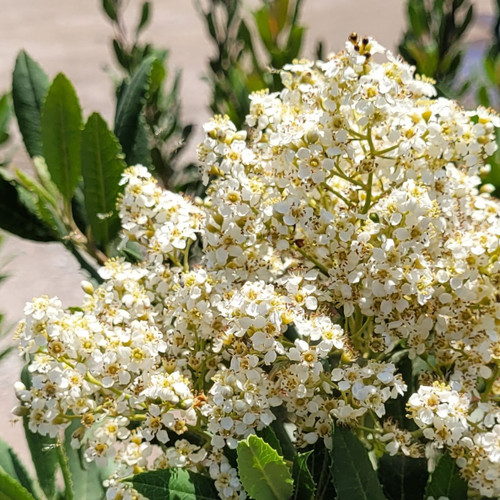
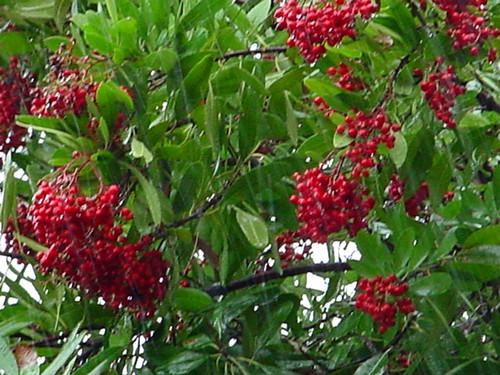
Heteromeles arbutifolia ‘Davis Gold’ is a rare golden-yellow fruited selection of California toyon (California holly), an evergreen shrub native to chaparral, coastal sage scrub, oak woodland, foothill woodland, and mixed evergreen forest communities throughout California and northern Baja California. Introduced through the University of California, Davis, this selection is distinguished by clusters of golden-yellow berries that replace the characteristic red fruit of the species. Widely regarded as having improved disease resistance compared to typical toyon, it retains the durability, drought tolerance, and exceptional wildlife value that make toyon one of California's most important native shrubs for habitat restoration and landscape use throughout Southern California. Habit & Size: Forms a dense evergreen shrub typically 8–15 feet tall and wide, with dark green, leathery foliage and an upright to broadly rounded habit. Clusters of white flowers are produced in early summer and are highly attractive to native bees and other pollinators. The flowers are followed by abundant golden-yellow berries that persist through fall and winter, providing ornamental interest and an important food source for birds and other wildlife. Cedar waxwings, Northern mockingbirds, California thrashers, and numerous other native and migratory bird species utilize the fruit during fall and winter. Cultural Requirements: Performs best in full sun to part shade and adapts to a wide range of soil types, including clay soils, provided drainage is adequate. Requires regular irrigation during establishment but becomes highly drought tolerant with age. Particularly well suited to Southern California landscapes, including low-water gardens, habitat plantings, oak woodland settings, and coastal landscapes. Tolerates heat, slopes, reflected heat, and challenging dry conditions once established. Landscape Uses: An excellent choice for screening, hedgerows, habitat restoration, and large-scale native landscapes. Useful in California native gardens, bird gardens, pollinator gardens, oak woodland plantings, chaparral plantings, wildlife habitat plantings, and low-water landscapes. The unusual yellow fruit provides a distinctive alternative to the red berries of the species while maintaining the ecological benefits that make toyon a foundational California native shrub. Identification Note: Often associated with the yellow-fruited form Heteromeles arbutifolia var. cerina, though the taxonomy of yellow-fruited toyon populations remains unresolved. Pests and Cultural Considerations: Generally low maintenance and highly durable. Fire blight can occur, particularly in nursery production, irrigated landscapes, or during periods of warm, humid weather. Leaf spot diseases, including Entomosporium leaf spot, may occasionally develop under conditions of poor air circulation, prolonged leaf wetness, or overhead irrigation and can result in spotting, defoliation, or shot hole-like symptoms. Aphids, scale insects, and mealybugs may occasionally occur but rarely cause significant damage on established plants. Avoid excessive summer irrigation, which can increase disease pressure and reduce drought tolerance. Best performance is achieved with good air circulation, well-drained soils, and deep, infrequent irrigation once established.
- Common Name:
- Yellow Berry Toyon
- Mature Height:
- 8-20'
- Mature Spread:
- 10-20'
- Exposure:
- Sun
- Growth:
- Evergreen
- Flower Color:
- White w/Yellow Berry