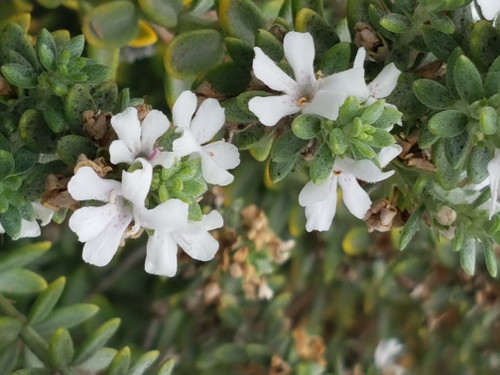
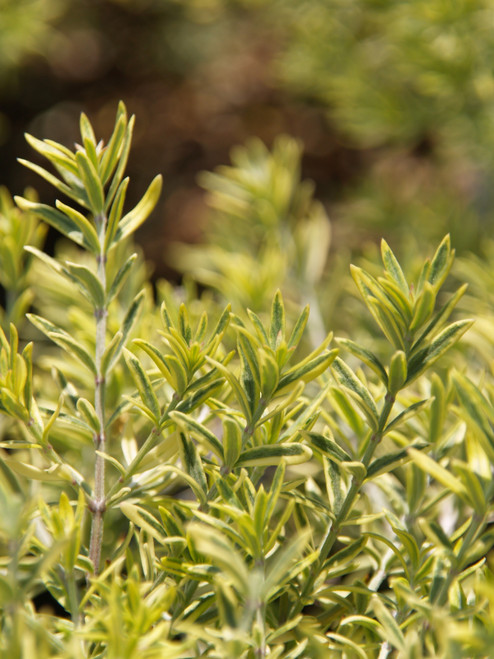
Westringia fruticosa (Coastal Rosemary, Australian Rosemary) is a versatile evergreen shrub native to coastal regions of eastern Australia. It is widely used as a drought-tolerant hedge, privacy screen, and low-maintenance landscape shrub throughout Southern California, particularly in water-wise, Mediterranean-style, and coastal landscapes. Although unrelated to true rosemary (Salvia rosmarinus, Rosmarinus officinalis), its narrow gray-green foliage resembles the culinary herb while offering strong tolerance of drought, salt spray, wind, and regular pruning. Known for dense evergreen growth, an extended flowering season, and adaptability to a wide range of landscape conditions, Westringia fruticosa is useful where year-round structure and dependable low-maintenance performance are desired.
Quick Facts:
Botanical Name: Westringia fruticosa
Common Name: Coastal Rosemary, Australian Rosemary
Plant Type: Evergreen shrub
Mature Size: Approximately 4–6 feet tall and 6–8 feet wide
Exposure: Full sun to partial shade
Water: Low once established
Soil: Well-drained sandy, loamy, rocky, or clay soils; tolerant of poor soils and coastal conditions
Bloom Season: Spring through fall, with sporadic flowering possible year-round in mild climates
Flower Color: White with pale lavender to purple spotting
Foliage Color: Gray-green
Wildlife Value: Nectar-rich flowers attract bees and other pollinating insects
Origin: Coastal eastern Australia
Deer Resistance: Moderately deer resistant
Landscape Uses: Hedges, privacy screens, foundation plantings, borders, mass plantings, slopes, coastal landscapes, commercial landscapes, streetscapes, parking lot islands, and water-wise gardens
Habit & Size: Westringia fruticosa forms a dense, rounded evergreen shrub with a naturally compact growth habit. Narrow gray-green leaves are arranged in whorls around the stems, creating a fine-textured appearance that remains attractive throughout the year. Small white flowers marked with pale lavender to purple spotting appear along the stems over an extended bloom season. Mature plants typically reach 4–6 feet tall and 6–8 feet wide, although regular pruning can maintain a smaller size or create formal hedges and topiary forms. Dense branching provides year-round screening and landscape structure.
Cultural Requirements: Coastal Rosemary performs best in full sun but also grows in partial shade, particularly in warmer inland locations. It thrives in well-drained soils and is highly drought tolerant once established, requiring only occasional deep irrigation during prolonged dry periods. This species tolerates coastal exposure, salt spray, wind, reflected heat, and poor soils, making it suitable for challenging landscape sites throughout Southern California. Plants may become more open and less dense in heavier shade or with insufficient light. Light pruning after flowering or periodic shaping encourages dense branching and maintains a compact appearance. Avoid prolonged saturated soils, which may contribute to root problems and reduced vigor.
Landscape Uses: Coastal Rosemary is commonly used as a drought-tolerant hedge, evergreen privacy screen, foundation planting, border shrub, mass planting, and erosion-control plant on slopes. Its dense evergreen foliage provides year-round screening and structure, while its tolerance of drought, coastal conditions, and regular pruning makes it useful in residential landscapes, commercial developments, streetscapes, parking lot islands, and other low-maintenance public landscapes. It is also appropriate for coastal landscapes, pollinator-oriented plantings, contemporary designs, and California-friendly landscapes where dependable evergreen coverage and fine texture are desired.
Identification Note: Although Westringia fruticosa resembles culinary rosemary (Salvia rosmarinus / Rosmarinus officinalis) because of its narrow gray-green foliage, it is a different plant grown primarily as an ornamental landscape shrub rather than a culinary herb. It is distinguished by its dense rounded habit, whorled leaves, and small white flowers with lavender to purple spotting. Its strong response to pruning and naturally compact form make it common in formal hedges, borders, and maintained landscapes.
Pests and Cultural Considerations: Westringia fruticosa is generally a resilient, low-maintenance shrub when planted in well-drained soils. Overwatering or poorly drained sites may lead to root problems and reduced vigor. Aphids, scale insects, or spider mites may occasionally occur but rarely cause significant damage to healthy, established plants. Plants grown with excessive irrigation or insufficient sunlight may develop a looser habit and reduced flowering. Periodic thinning or light pruning improves air circulation, encourages fresh growth, and helps maintain a dense canopy. Once established, Coastal Rosemary tolerates drought, heat, coastal exposure, and urban growing conditions.
Frequently Asked Questions:
Is Westringia fruticosa the same as rosemary? No. Although its foliage resembles culinary rosemary, Coastal Rosemary is a different species grown as an ornamental landscape shrub rather than a culinary herb.
Is Coastal Rosemary evergreen? Yes. Westringia fruticosa is an evergreen shrub that provides year-round foliage, screening, and landscape structure.
Is Coastal Rosemary drought tolerant? Yes. Once established, it requires relatively little supplemental irrigation and is well suited to water-wise landscapes.
How large does Westringia fruticosa grow? Most plants mature approximately 4–6 feet tall and 6–8 feet wide, although they can be maintained smaller through regular pruning.
Is Coastal Rosemary fast growing? It has a moderate growth rate and establishes relatively quickly under favorable growing conditions, especially with regular irrigation during establishment.
Does Coastal Rosemary make a good hedge? Yes. Its dense evergreen foliage and strong response to pruning make it well suited for formal and informal hedges, privacy screens, and borders.
Can Coastal Rosemary be kept small? Yes. It responds well to pruning and can be maintained as a compact shrub or shaped into formal hedges and geometric forms.
Does Coastal Rosemary attract pollinators? Yes. Its nectar-rich flowers attract bees and other beneficial pollinating insects throughout much of the growing season.
Can Coastal Rosemary grow near the ocean? Yes. It tolerates salt spray, coastal winds, and sandy soils, making it suitable for coastal landscapes.
Is Coastal Rosemary suitable for Southern California landscapes? Yes. Its drought tolerance, adaptability, evergreen foliage, and low-maintenance requirements make it a commonly used shrub throughout Southern California landscapes.
- Common Name:
- Australian Rosemary
- Mature Height:
- 4-6'
- Mature Spread:
- 6-8'
- Exposure:
- Sun/Part Sun
- Growth:
- Evergreen
- Flower Color:
- White
- Foliage Color:
- Grey/Green
- Flower Time:
- Winter - Summer
![Westringia Blue Gem ['WES03'] PPAF 5g](https://cdn11.bigcommerce.com/s-x68mczjd0x/images/stencil/500x659/products/1606/4542/Westringia_Blue_Gem_flower__43504.1562384247.jpg?c=2 "Westringia Blue Gem ['WES03'] PPAF 5g")